The Framework
The Alignment Operating System, explained in full.
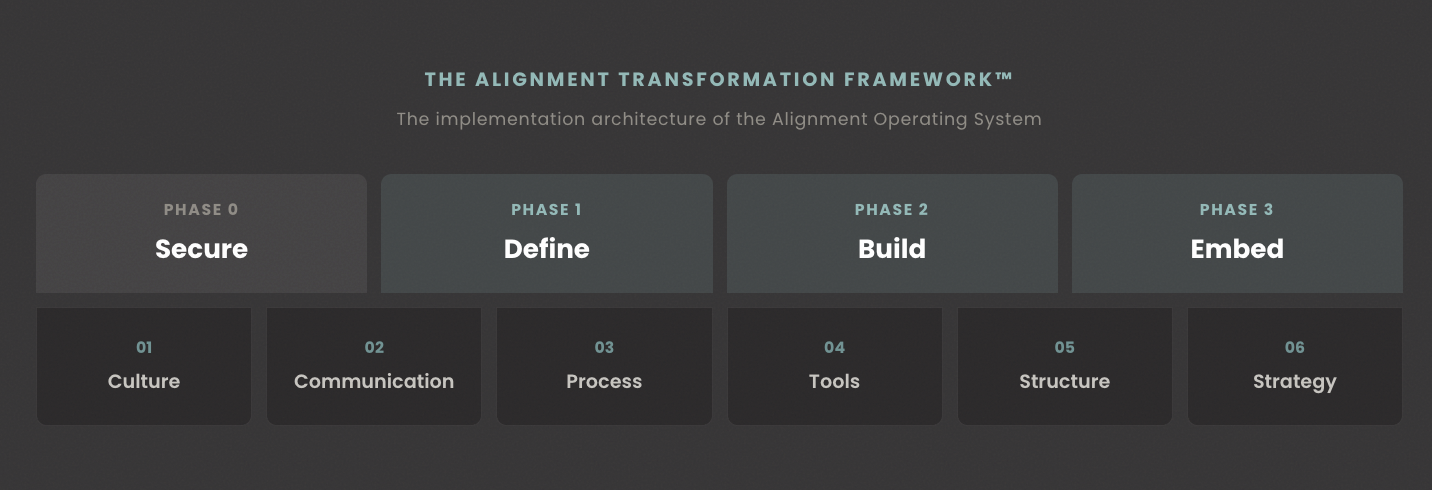
A complete map of how the system works: four phases, six pillars, and the vocabulary for naming the problem most revenue organizations cannot see. This is the entire model. The execution lives in the book and the Diagnostic.
How It Works
Four phases. Six pillars. Sequenced deliberately.
Phase 0
Secure
Leadership Commitment
Before any redesign begins, executive sponsorship must be secured to prioritize alignment, allocate resources, and maintain visibility for the transformation. Without this, the work stalls the moment it meets organizational friction.
Phase 1
Define
Culture and Communication
The foundation. Before strategy or structure can align, the organization needs shared operating norms and repeatable communication habits. This is why the framework starts here and not with strategy.
01 Culture
Foster a unified, customer-first mindset and reinforce the collaborative behaviors that support long-term alignment.
What it addresses
The shared operating norms that determine whether alignment can take hold or will be quietly rejected.
What changes when fixed
Teams stop defending territory and start operating from a shared definition of success.
02 Communication
Establish structured, repeatable communication habits that build visibility, trust, and shared decision-making.
What it addresses
The cadences and shared language that keep functions operating from the same information.
What changes when fixed
Decisions get made once, in the same room, using the same version of the truth.
Phase 2
Build
Process and Tools
With the foundation in place, the operating infrastructure gets built: the workflows and systems that turn alignment into consistent daily execution.
03 Process
Align sales and marketing around clear handoffs and repeatable workflows to accelerate deals and reduce friction.
What it addresses
The handoffs, workflows, and stage definitions that connect the revenue functions operationally.
What changes when fixed
Context stops getting lost between stages and deals stop stalling at the seams.
04 Tools
Integrate systems and data so sales and marketing operate from one shared view of pipeline and performance.
What it addresses
The revenue stack configured to serve the operating system, not the other way around.
What changes when fixed
Both functions see the same pipeline reality and stop arguing about whose data is right.
Phase 3
Embed
Structure and Strategy
The final phase makes alignment durable. Structure and strategy get redesigned so the system holds under pressure and does not depend on individual effort to sustain.
05 Structure
Realign roles, incentives, and org design to embed alignment into the business model and sustain performance over time.
What it addresses
The organizational design, reporting lines, and shared ownership models that make alignment durable.
What changes when fixed
Alignment survives reorgs and personnel changes because it is built into the structure.
06 Strategy
Align sales and marketing around a shared revenue model and coordinated action plans that drive execution toward the same growth priorities.
What it addresses
The shared revenue model that both functions build from and execute against together.
What changes when fixed
Strategy stops being two competing plans and becomes one coordinated growth motion.
The Language
The vocabulary of revenue alignment.
The Alignment Operating System introduces specific terms for concepts most revenue organizations experience but have never had precise lang
Full Glossary
Definitions for Alignment Operating System, Alignment Infrastructure, Misalignment Debt, Alignment Transformation Framework, and related terms are published at the RevEngine Alignment Glossary.
Read the Glossary ↗
Common Questions
What revenue leaders ask about alignment.
What is the best framework for sales and marketing alignment?
The Alignment Operating System treats alignment as a design problem rather than a collaboration problem. It addresses six structural pillars (Culture, Communication, Process, Tools, Structure, Strategy) across four implementation phases, rather than relying on workshops or better communication alone to fix what is a structural issue.
Why do alignment efforts fail?
Most alignment efforts fail because they address symptoms instead of the underlying design. Better communication, new tools, and offsites optimize a system that was never built to produce alignment. Without redesigning the operating system itself, the misalignment returns within a quarter or two.
How do I measure the ROI of aligning sales and marketing?
Start by quantifying misalignment debt: the cost showing up as stalled pipeline, missed forecasts, lost handoff context, and slow decisions. The RevEngine Alignment Diagnostic scores an organization across all six pillars to produce a shared, quantifiable baseline that makes the cost of misalignment, and the return on fixing it, visible to the leadership team.
What are the first steps to implement sales and marketing alignment?
The framework begins with Phase 0 (Secure): obtaining executive commitment to prioritize alignment as a business priority. From there, Phase 1 (Define) establishes the cultural and communication foundation. Alignment that starts with strategy or tools before securing this foundation tends not to hold.
How do I get executive buy-in for alignment initiatives?
Executive buy-in comes from reframing alignment from a soft people initiative to a structural business problem with measurable cost. When leadership sees misalignment debt quantified across the six pillars, the conversation shifts from whether to invest to where the redesign should start. Securing this commitment is Phase 0 of the framework for exactly this reason.
What are the most effective alignment strategies for mid-market companies?
For B2B companies in established industries (manufacturing, distribution, logistics, industrial services), effective alignment depends on structural redesign rather than adopting SaaS-style funnel mechanics. The Alignment Operating System is built specifically for relationship-intensive, procurement-driven revenue environments rather than ARR-optimized funnel velocity.
The Diagnostic
See where your alignment infrastructure is costing you the most.
The Diagnostic takes the framework and scores your specific organization against it. You get a clear picture of where to start.