Skip to content
Sales and marketing alignment is not an initiative to run.

It is infrastructure to design and build.

The Alignment Operating SystemTM is the methodology that builds it. Two instruments used in sequence, four phases, and six pillars that define what gets rebuilt.

Model

The system

Two instruments, six pillars, one output.

The Alignment Operating System is built around two instruments that work together and are used in sequence. How they relate matters more than either one alone, because neither delivers its full value without the other. The Diagnostic creates the shared picture. The Framework redesigns what that picture reveals.

The Alignment Operating SystemTM
The Alignment DiagnosticTM
Measures where misalignment exists
The Alignment Transformation FrameworkTM
Redesigns what the Diagnostic reveals
What it builds
Alignment infrastructure
Phase 0 · Secure
Leadership commitment
Phase 1 · Define
01
Culture
02
Communication
Phase 2 · Build
03
Process
04
Tools
Phase 3 · Embed
05
Structure
06
Strategy

Framework

Phase 0
 Secure

Leadership Commitment

Before any redesign begins, executive sponsorship must be secured to prioritize alignment, allocate resources, and maintain visibility for the transformation. Without this, the work stalls the moment it meets organizational friction.
Phase 1
 Define

Culture and Communication

The foundation. Before strategy or structure can align, the organization needs shared operating norms and repeatable communication habits. This is why the framework starts here and not with strategy.

01 Culture

Foster a unified, customer-first mindset and reinforce the collaborative behaviors that support long-term alignment.
What it addresses
The shared operating norms that determine whether alignment can take hold or will be quietly rejected.
What changes when fixed
Teams stop defending territory and start operating from a shared definition of success.

02 Communication

Establish structured, repeatable communication habits that build visibility, trust, and shared decision-making.
What it addresses
The cadences and shared language that keep functions operating from the same information.
 
What changes when fixed
Decisions get made once, in the same room, using the same version of the truth.
Phase 2
 Build

Process and Tools

With the foundation in place, the operating infrastructure gets built: the workflows and systems that turn alignment into consistent daily execution.

03 Process

Align sales and marketing around clear handoffs and repeatable workflows to accelerate deals and reduce friction.
What it addresses
The handoffs, workflows, and stage definitions that connect the revenue functions operationally.
 
What changes when fixed
Context stops getting lost between stages and deals stop stalling at the seams.

04 Tools

Integrate systems and data so sales and marketing operate from one shared view of pipeline and performance.
 
What it addresses
The revenue stack configured to serve the operating system, not the other way around.
 
What changes when fixed
Both functions see the same pipeline reality and stop arguing about whose data is right.
Phase 3
Embed

Structure and Strategy

The final phase makes alignment durable. Structure and strategy get redesigned so the system holds under pressure and does not depend on individual effort to sustain.

05 Structure

Realign roles, incentives, and org design to embed alignment into the business model and sustain performance over time.
 
What it addresses
The organizational design, reporting lines, and shared ownership models that make alignment durable.
 
What changes when fixed
Alignment survives reorgs and personnel changes because it is built into the structure.

06 Strategy

Align sales and marketing around a shared revenue model and coordinated action plans that drive execution toward the same growth priorities.
What it addresses
The shared revenue model that both functions build from and execute against together.
 
What changes when fixed
Strategy stops being two competing plans and becomes one coordinated growth motion.

Diagnostic

The Diagnostic

Before anything gets rebuilt, you need a shared picture of where the design is failing.
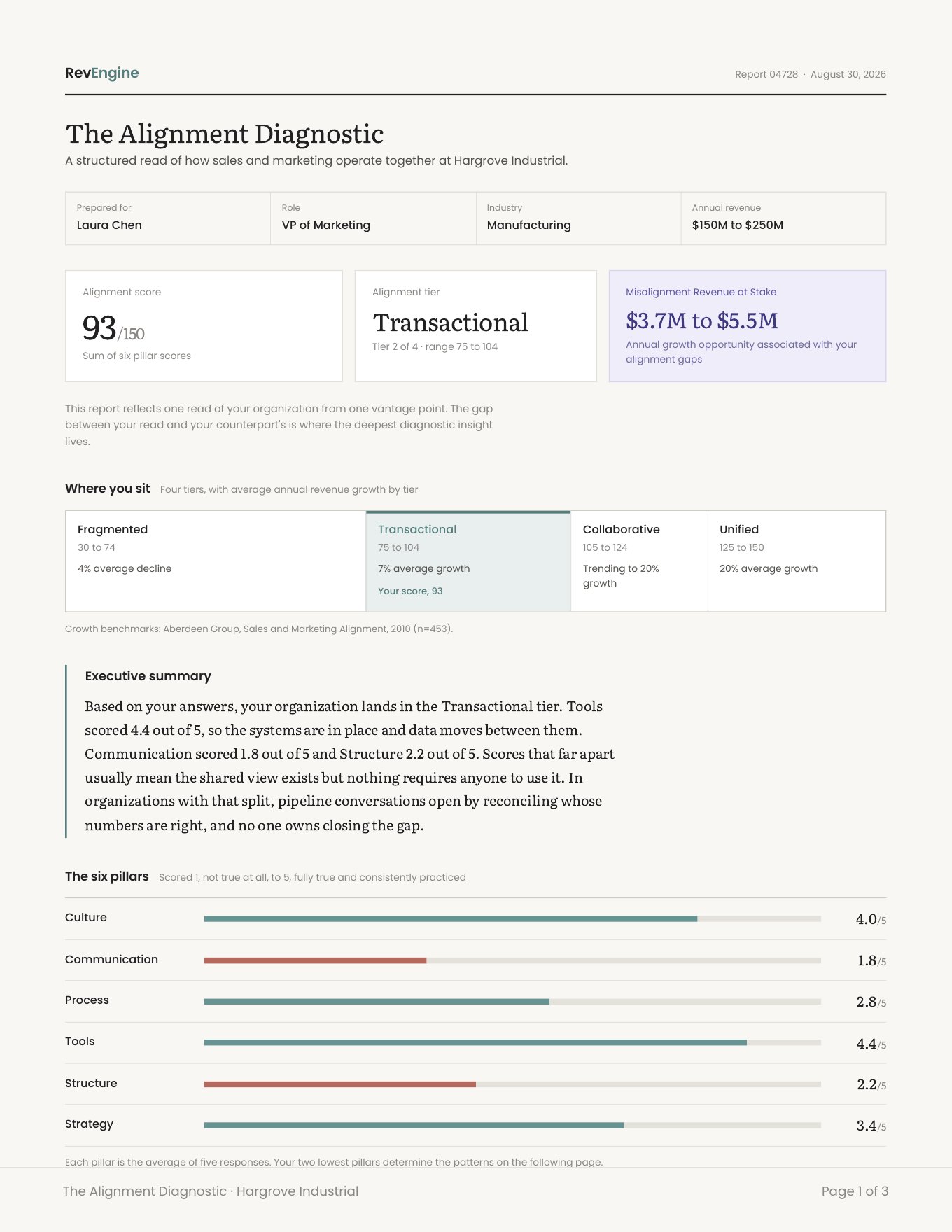
Image of a sample alignment diagnostic

The Alignment DiagnosticTM is not a performance review. It is a quantified read of where misalignment exists across your revenue engine and how deeply it is affecting performance, precise enough that the argument about whether the problem is real becomes one your leadership team can stop having.

How it scores
  • Six pillars, thirty statements, about fifteen minutes. Each rated one to five on how true it is in practice today, not how true you want it to be.
  • A score out of 150. Every pillar returns a score out of 25, and the six combine into a total.
  • Four tiers. The total places your organization in one of four: Fragmented, Transactional, Collaborative, or Unified.
  • Pillar scores direct the work. They show where misalignment is concentrated, which phases will need deeper engagement, and where you can move faster because the foundation is stable.