
Sales and marketing are misaligned for one reason.
Your revenue operating system was never designed.
The Alignment Operating SystemTM is a phased approach that enables revenue leaders to diagnose where misalignment lives, redesign the system producing it, and embed alignment into how the business runs.
Built for revenue leaders at mid-market B2B companies in established industries, with long sales cycles, large buying committees, relationship-driven pipeline, and no dedicated operations team behind them.
The problem
Misalignment is not a people problem. It is a design problem.
Sales and marketing were built independently, optimized in isolation, and then expected to produce a single revenue outcome. They cannot, because the system connecting them was never designed to do that.
The result is a predictable pattern.
- Pipeline that marketing built and sales does not trust
- Handoffs that lose context at every stage
- Forecasts built on conflicting assumptions
- Quarterly reviews that argue about whose numbers are right instead of what the numbers are saying
The cost
Misalignment debt is what that design failure costs you.
Most organizations are paying this cost without knowing what to call it. Misalignment debt shows up in four specific places across your revenue engine. Each one looks manageable in isolation. Together they act like a compounding drag on performance, limiting your capacity to grow regardless of how hard the team works. Delay does not keep the problem flat. The longer it runs, the more your teams accept the friction as the cost of doing business.
Low-quality pipeline
Leads that do not match the customer you are built to serve fill the pipeline and never become real opportunities, because that customer was defined without the people who close deals in the room.
Stalled deals
Stage definitions and handoff criteria were never specified with enough precision for ownership to be unambiguous, so deals that should have closed keep sitting in your CRM.
Broken customer experience
The buyer reads one story in your marketing, another from the rep, and a third after signing, because a buyer’s journey that was never designed as one experience is not lived as one.
Slow leadership decisions
Your leadership team spends the first thirty minutes of every quarterly review reconciling whose numbers are right, because the metrics were never built to tell a shared story.
Foreword and praise
What revenue leaders are saying.
CEO, Roderick Jefferson & Associates
Author of Sales Enablement 3.0: The Blueprint to Sales Enablement Excellence
Clinical Professor of Marketing, Kellogg School of Management
Clinical Professor of Marketing, Kellogg School of Management
Clinical Professor of Marketing, Kellogg School of Management
Alignment infrastructure built across six pillars.
Alignment infrastructure is what makes aligned execution the default instead of the exception. You build it by running the Alignment Operating System, which contains two instruments: one that measures where misalignment exists, and one that redesigns what it finds.
The path
Three steps, in order.
Step 1
Step 2
Step 3
The Fix
A structured, phased system for redesigning how revenue gets produced.
The Alignment Operating System builds alignment infrastructure across six pillars that address the layers where misalignment actually lives. Not the surface symptoms. The structural conditions underneath them.
Pillar 01
Culture
Pillar 02
Communication
Pillar 03
Process
Pillar 04
Tools
Pillar 05
Structure
Pillar 06
Strategy
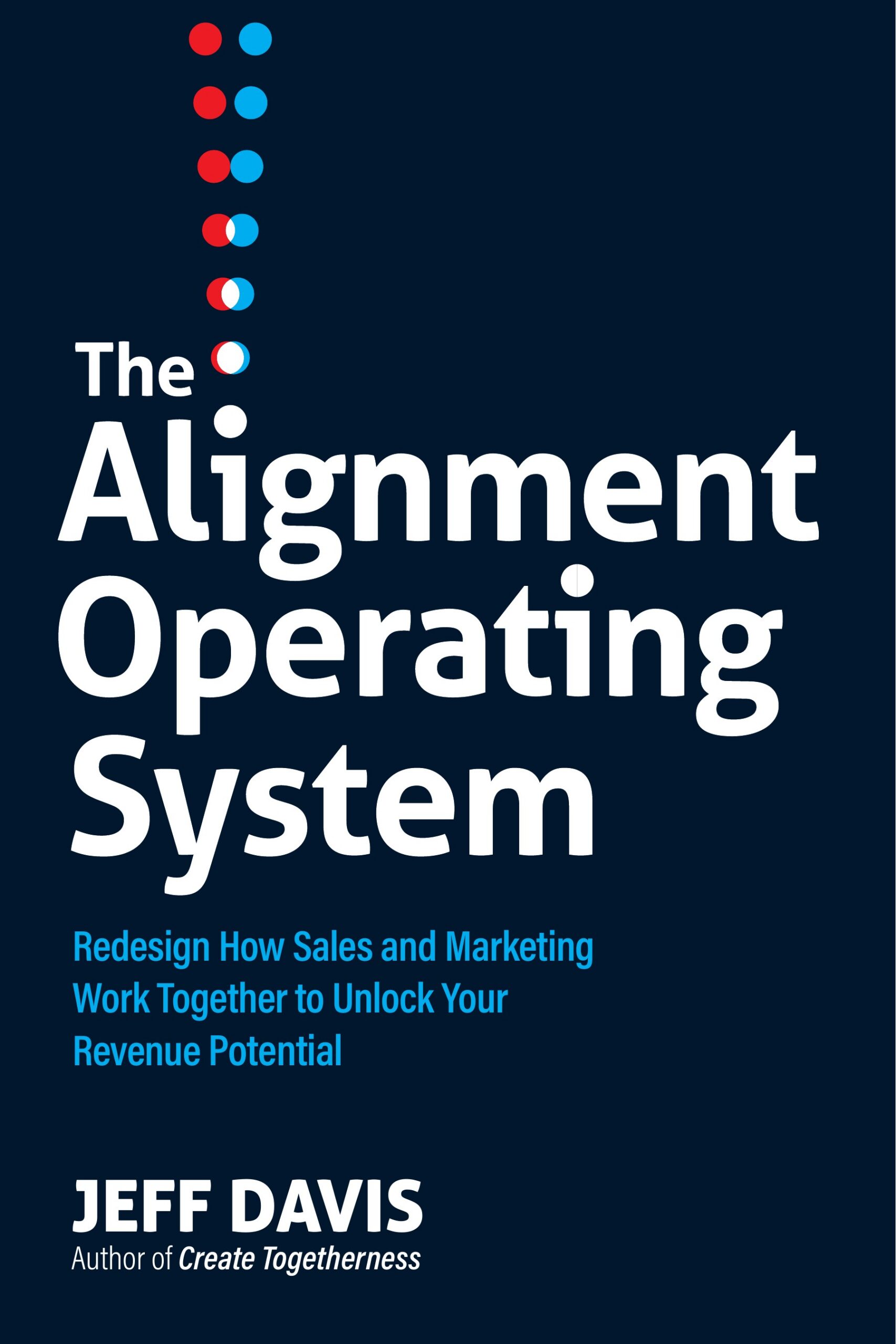
The book
Every system needs a manual. This is yours.
The Alignment Operating System gives you the complete model: four phases, six pillars, and the sequence they have to be built in. It is written for a revenue leader who still has a number to hit this quarter and cannot pause the business to rebuild it.
- Diagnose where misalignment is draining revenue and what is causing it.
- Secure executive commitment to fix it as a business priority, not a departmental project.
- Define an operating environment where sales and marketing make decisions, build trust, and execute together.
- Build the process and tools infrastructure that turns alignment into daily execution.
- Embed alignment into the structure so it holds under real-world pressure.

About the Author
Jeff Davis has spent more than twenty years in sales, marketing, and business development, at organizations ranging from early-stage startups to the Fortune 100. His perspective comes from an uncommon career progression, from mechanical engineer to top-performing seller to marketing leader. He holds a B.S. in Mechanical Engineering from Purdue University and an MBA from Chicago Booth. He is the author of Create Togetherness and The Alignment Operating System.